$2,800.00
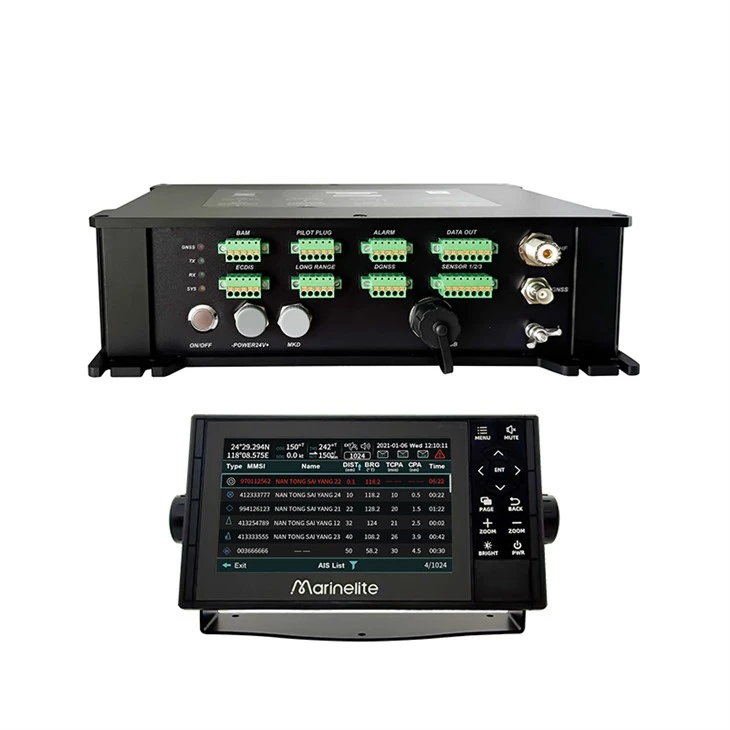
Description of the Marinelite marine ais class a
n
nOur Marine AIS Class A is a high-performance device that is designed to receive AIS targets and send relevant static and dynamic parameters, as well as related navigation data. With a wide range of intelligent alarms and real-time collision avoidance information, it helps ensure the safety of your vessel, crew, and cargo.
nBy accessing various ship sensors, such as GNSS, odometers, compass, and rate of turn indicator, this product is able to provide accurate and reliable data to help you make informed decisions while navigating in busy, congested waters.
nOur Marine AIS Class A complies with a range of international standards, including IMO MSC.302(87), ITU-R.M.1371-5, IEC 62288, IE61993-2 2018, and IEC 60945, confirming its superior quality and reliability.
n
n
n
nFEATURES of the Marinelite marine ais class a
n
n• 7″or 10.1″ ultra-bright high contrast colour LCD
n
n• Two operation modes: Touch screen, keypad.
n
n• Pilot plug interface
n• Use USB memory for quick software upgrades
n
n• Water resistant design
n
n• Full AIS SART support
n• Text messaging
n• VHF communication test function
n
n
n
nApplications of the Marinelite marine ais class a
n
nAIS Class A:
nmandated by the IMO for vessels of 300 gross tonnages and upwards engaged on international voyages, cargo ships of 500 gross tonnages and upwards, as well as passenger ships. It transmits typically on 12.5 watt output power.
n
n
n
nApplication Guide: How Class A AIS Solves Real-World Vessel Operational Challenges
nFor commercial ship operators, captains, and fleet managers, navigating open waters and congested ports means constant pressure: avoiding collisions, complying with international regulations, maintaining situational awareness, and streamlining daily operations. Many vessels struggle with outdated tracking, delayed communication, poor visibility in high-traffic zones, and non-compliance with SOLAS mandates-issues that risk safety incidents, fines, and operational downtime. Our Class A AIS transceiver is purpose-built to resolve these exact pain points, delivering reliable, real-time data and compliance that keeps your fleet safe, efficient, and fully aligned with global maritime standards.
nWhat Makes Class A AIS Different-and Critical for Your Vessel
nUnlike lower-power Class B units, Class A AIS is the IMO-mandated solution for all commercial vessels over 300 gross tons and passenger ships operating internationally. It operates at 12.5W transmission power-six times stronger than Class B-delivering a signal range of 20–30+ nautical miles in clear conditions, ensuring you never miss critical vessel data beyond the horizon. Its Self-Organized Time Division Multiple Access (SOTDMA) protocol reserves dedicated transmission slots, guaranteeing your vessel’s data is sent and received without delay, even in the busiest shipping lanes. This isn’t just a tracking tool; it’s a proactive safety and operational system designed for the unique demands of commercial maritime work.
nSolving Your Top Vessel Challenges: Real-World Use Cases
n1. Eliminating Collision Risks in All Conditions
nThe problem: In fog, heavy rain, or crowded straits, radar alone can miss small or fast-moving vessels; manual visual checks are unreliable and slow. Close-quarters situations lead to near-misses, costly damage, or worse.
nHow Class A AIS fixes it: It dynamically updates your vessel’s position, speed, course, and navigation status every 2–12 seconds (faster during sharp turns or high-speed maneuvers). Every nearby AIS-equipped ship, tug, or port vessel appears on your ECDIS, radar, or AIS display with clear identifiers: MMSI number, ship name, type, and intended route. You see threats before they’re visible, make informed course adjustments, and avoid dangerous encounters-no guesswork required.
n2. Ensuring Full SOLAS & Regulatory Compliance (No More Fines)
nThe problem: Non-compliant vessels face port state control detentions, heavy fines, and delayed sailings. Many operators struggle to meet IMO/SOLAS mandates for mandatory AIS equipment on international voyages.
nHow Class A AIS fixes it: Our unit is fully certified to meet IEC 61993-2 and SOLAS Chapter V requirements. It transmits all mandatory static and dynamic data (vessel dimensions, cargo type, ETA, position updates) as required by global authorities. With built-in compliance logging and real-time status monitoring, you sail with confidence-no last-minute inspections, no penalties, and no disruptions to your schedule.
n3. Enhancing Situational Awareness for Bridge Teams
nThe problem: Bridge officers juggle radar, GPS, and manual charts, leading to information overload and missed critical alerts. Poor awareness of nearby vessel intentions increases operational risk.
nHow Class A AIS fixes it: It integrates seamlessly with your bridge systems-ECDIS, radar, voyage recorders, and pilot plugs-creating a single, unified navigation picture. The dedicated Minimum Keyboard and Display (MKD) lets your team send and receive high-priority safety messages: targeted warnings to specific vessels, broadcast navigational hazards (e.g., floating debris, fog banks), and distress alert relays. You stay connected to shore VTS centers and neighboring ships, with full visibility of every vessel in your operating area.
n4. Streamlining Port & Traffic Management
nThe problem: Congested ports, narrow channels, and busy anchorages cause delays, inefficient maneuvering, and miscommunication between vessels and port authorities.
nHow Class A AIS fixes it: Shore-based VTS systems rely on continuous Class A AIS data to monitor traffic, guide vessel movements, and allocate berths safely. Your vessel’s real-time position and status data help port controllers manage flow efficiently, reducing waiting times and streamlining arrivals/departures. For your crew, this means smoother port operations, less idle time, and faster turnaround-directly boosting fleet productivity.
n5. Supporting Search & Rescue (SAR) & Incident Reconstruction
nThe problem: In emergencies, delayed or inaccurate vessel location data slows SAR response. Post-incident investigations lack objective records, making root-cause analysis difficult.
nHow Class A AIS fixes it: In distress, the unit instantly transmits your vessel’s exact position, course, and speed to all nearby ships and coastal stations-critical for rapid SAR deployment. All AIS data is logged to your voyage data recorder (VDR), providing an unbiased, time-stamped record of events for accident investigations. This not only speeds up rescue efforts but also protects your fleet with verifiable operational data.
nWhy Choose Our Class A AIS for Your Fleet
nOur Class A AIS isn’t just compliant-it’s built for real-world maritime use:
nRugged, marine-grade design: Withstands harsh saltwater, vibration, and extreme temperatures, ensuring 24/7 operational reliability.
nEasy integration: Plug-and-play compatibility with GNSS, gyro, log, and existing bridge systems, minimizing installation downtime.
nLow maintenance: Simple daily operational checks and annual performance tests keep the unit running at peak efficiency.
nGlobal support: Backed by our maritime technical team, with OEM/ODM customization available to fit your fleet’s specific needs.
nFinal Takeaway
nClass A AIS isn’t an optional add-on-it’s a foundational solution to the daily challenges commercial vessel operators face. It turns uncertainty into clarity, non-compliance into confidence, and risk into safety. By delivering real-time, high-priority data, seamless system integration, and unwavering regulatory adherence, our Class A AIS transceiver keeps your crew safe, your fleet compliant, and your operations running smoothly-no matter where your voyage takes you.
nFor more details on installation, certification, or custom fleet solutions, contact our maritime specialists today.
n
| Power source | DC24V |
| Class | ClassA |
| Bandwidth | 25KHz |
| Modulation scheme | GMSK |
| Bit rate | 9600bps |
| Frequency | 156.025MHz~162.025MHz |
| AIS TX Channel/Frequency | AIS1(CH87B):161.975MHz n nAIS2(CH88B):162.025MHz |
| AIS RX Channel/Frequency | AIS1(CH87B):161.975MHz n nAIS2(CH88B):162.025MHz |
| DSC RX Channel/Frequency | 70/156.525MHz |
| Receiving sensitivity | Better than -107dBm |
| Frequency Error | <±500hz |
| RF out Power | 1W/12.5W |
| GNSS RX Frequency | BDS:B1I:1561.098MHz |
| GPS:L1 1575.42MHz | |
| Interface | BAM n nPILOT PLUG n nData output x 3 n nECDIS: Bidirectional data interface n nLONG RANGE: bidirectional data interface n nDGNSS n nSensor data input x 3 |
| Performance Standard Compliant | IEC 61993-2 2018 n nR-REC-M.1371-5-2014 n nIMO MSC.74(69) n nIMO MSC.302(87) n nIEC 62923-1 n nIEC 62923-2 n nIEC 62288 -2021 n nIEC61162-1 n nIEC61162-2 n nIEC60945 |
| MKD Display | 7inch or 10.1 inch options |
| Display language: Simplified Chinese, Traditional Chinese, English |
n
Not able to find the product you need in our catalogue?
Tell us what you need and we will search for you.